 IDEN Join WA Group
LOGIN
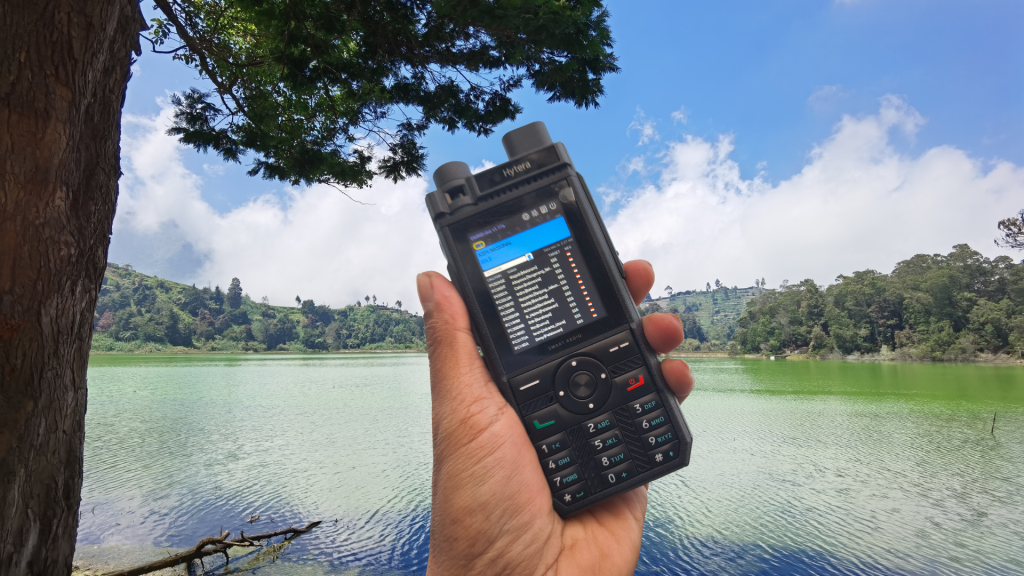
With the rapid development of portable radio technology, including digital technology in Handy Talky (HT) and Mobile Radio (Rig) known as Digital Mobile Radio (DMR), which is very efficient because it does not use too many frequencies for radio communication, the range achievable point to point (P2P) is farther and the resulting sound is very clear, free of the noise typical of analog radio.
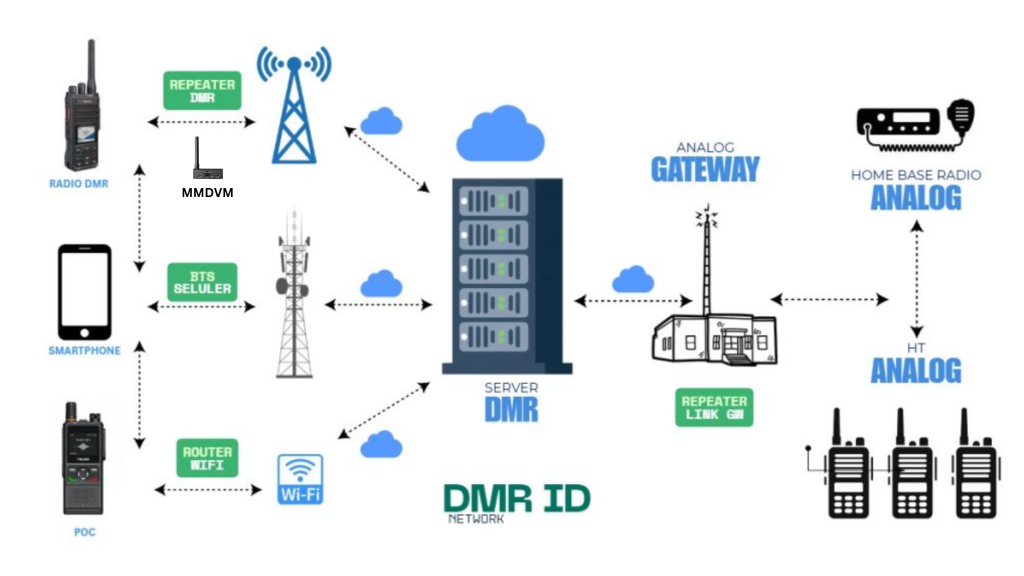
Basically, Digital Mobile Radio is a radio device that can communicate Point to Point (P2P) / directly from radio to radio), but its advantage is that it is equipped with a decoder and encoder that converts voice (vocoder) and text into digital data superimposed on the Radio Frequency (RF) signal when transmitting, and conversely converts the digital data superimposed on the received RF signal back into voice or text when receiving.
This means digital data is carried over the RF signal, not voice as in analog radio, so the received sound is clear and free of the noise typical of analog radio.
Because the signals sent and received are digital data, DMR has many options for bridging transmission/reception between repeaters, such as data cables, fibre optic, and even IP gateways that can be applied through a dedicated server (DMR Server) to manage digital data containing voice or text, serving DMR-to-DMR communication with a very wide reach that can cover the entire country.
With the many advantages and efficiency of the DMR system, it would be very useful in disaster emergency communication in our country, because it can reach every corner of a disaster scene such as fires, floods, earthquakes and others, using more compact and efficient portable equipment.
Many do not realize that entering the DMR world means entering the world of databases: in a database system a single ID can identify all data about that ID, much like the NIK on a KTP. In a DMR network, order and clear identification are also needed to guarantee the integrity of users, especially during communication. With just the dmrid, all user data such as callsign, name and location will appear on the dashboard screen, even on the screen of a monitoring DMR HT device. For that reason there must be no duplicate dmrid within one DMR network.
That is why, in Indonesia's Public Information Communication (KIM) system, especially in digital communication, a DMR network manager is greatly needed, whose task is not only to provide communication facilities but also to manage the database system, because data must be identified and well managed so that it does not become chaotic when synchronizing data from sub-district, region and province up to the national level. In a DMR network every member must be registered and must have a dmrid and callsign so that member account data can be managed well and its integrity guaranteed on the DMR network.
There are also several communication equipment brands or amateur radio communities that have their own networks and their own DMR database systems with many users, such as Yaesu with the Fusion C4FM system, iCom and Kenwood with the NXDN system, and Japanese amateur radio with the D-Star network system, which was eventually acquired commercially by iCom in 2003.
One of the most important things in a DMR network is DMR identification (dmrid). A dmrid is an identification number for a personal contact, talkgroup, gateway or server port. This ID must be unique: no two IDs may be the same within one DMR network. We must therefore first check which network we will use to communicate via DMR. So it is no surprise that another person's callsign and name sometimes appear on a DMR HT or the Pistar dashboard; that is normal because we entered one DMR network while our MMDVM Hotspot data uses data from another DMR network.
The second important thing in a DMR network is callsign identification. A user's callsign relates to user data such as name, location and more; a talkgroup's callsign relates to talkgroup data such as name, location and function; a gateway's callsign relates to name, location, mode and function; and a DMR server's callsign relates to IP address, port number, name, location and function.
Even though a callsign system is already in use, radio communication communities in Indonesia are not yet aware of the importance of managing their member databases as DMR-based databases, as they are still influenced by the old stigma of relying only on analog radio. One Indonesian radio organization, although legally using DMR, still has no one directly managing callsign and dmrid data on a DMR network or its own server, and has so far merely relied on foreign servers, while the other organization is not yet open to developments for fear of violating the law, whether the organization's bylaws or ministerial regulations. Yet this is a very large organization with great potential if it is willing and determined to fight for permits and legal changes for the use of DMR networks within the organization.
Indonesia has K2PI with the DMRiD™ system, which applies only on the Indonesian DMR network and is prepared to meet the digital communication (DMR network) needs of the future.